Desert Online General Trading LLC
Dubai, United Arab Emirates
Desert Online General Trading LLC
Dubai, United Arab Emirates

🌟 Capture the unseen spectrum and stand out in every frame!
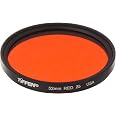
The HoyaR72 46mm Infrared Lens Filter allows 95% transmission of infrared light between 760nm and 860nm, enabling photographers to capture unique false color and high-contrast infrared images. Designed for mirrorless, DSLR, and film cameras, its screw-in mount ensures a secure fit while compatibility with other Hoya filters expands creative possibilities.


M**Y
Great into to IR photography and works very well
If you're wanting to try IR and not mod a camera, this is the way. Even on fairly older cameras, it will work pretty well as long as you have access to high ISO and are ok with grain/noise from it. You will do best with faster lenses and wide field of view so you don't need to stop down f-stop and reduce light, you need a lot of light to shoot in IR. So if you pick up a filter, set your ISO to max or near max and try low f-stop like F4 or so, wider angle lens, and do not shoot directly into the sun, look for things that reflect sun and you'll see the effect of IR reflecting off things and showing up as bright white. The sky will darken, tree's go white, etc. 720nm+ longer IR will show this.I'm shooting this on my favorite carry camera, an older Fuji X100S. I have to shoot around F4, ISO 6400 to be able to hand hold shoot things without too slow of a shutter speed. No hot spot or issues with the lens, 23mm so naturally wide angle field of view. Photos attached to show example.
C**N
Does its job well
This filter blocks nearly all visible light. Consequently, it looks opaque and black to the naked eye, though if you hold it up to a strong light source, you will be able to see a dull, deep red image through it. The R72 is one of the most common filters used in infrared (IR) photography. If you get really serious about shooting in IR, you may want to look into having your camera modified to remove its built-in IR-blocking filter, but even with that filter in place, some cameras can be used for IR photography, given a suitably long exposure. (Incidentally, what we are talking about here is "near-infrared" light, which, although invisible to our eyes, behaves very much like normal light in the way it reflects off objects. This is not the same as seeing heat as light, which involves a deeper portion of the IR spectrum.)I have used this filter with an unmodified Canon EOS 5D Mark II digital SLR camera and a Canon EF 50mm f/1.8 lens (the original version from the 1980s, not the all-plastic one made now, which may or may not take the same size filters). The camera's auto-focus capability works perfectly with the filter in place. In direct sunlight, I have found that with the camera on a tripod, an exposure of about 15 seconds at f/5.6, ISO 400 produces a good image. After that, what to do is a matter of creative judgment; the picture obviously won't be in natural colors (that's the whole point of shooting in IR), so you can adjust white balance however you like. I often exchange the red and blue channels, as well. Sometimes I reduce the end result to grayscale, sometimes not.Now, one may ask at this point, if we are photographing infrared light, what is all this talk of red and blue and white? The answer is that the camera's sensor, though designed primarily to pick up visible light, is also somewhat sensitive to IR. However, the camera cannot distinguish between IR and visible light. The IR that it senses, it records (incorrectly) as shades of visible light (mostly red). This is what we see in digital IR photography. We are seeing, in colors we can see, an image made from light that we cannot see directly.IR photography is a lot of fun and at times it provides a strange sense of discovery. It is strange and sometimes thrilling to see our familiar world in such an unfamiliar way. The Hoya R72 filter is a good choice for IR work.
E**N
a great IR filter
a great IR filter.not like the other cheap fake filter I purchased before.I have both Canon 400D that doesn't had Hot Mirror and Canon 7D that had a Hot Mirror to reflect IR light, I'll post a comparison later.here's the setup I did to take the shot, but before that this is what you must carry with you.1- DSLR Camera2- Lens that support 77mm filter size. (consider that you may need Lens Hood for best quality)3- IR Filter4- Tripod5- Wire or Wireless remotetaking the shot:1- take over exposed shot for the grass with your IR filter. (the healthy grass and faced to the direct sun are recommended)*2- use the shot to make custom WB after that remove the IR Filter.*3- attach your Camera to your Tripod.4- setup the scene for the way you like and make sure you focus.**5- Turn off the AF.6- attach your IR filter and take a test shot with low Aperture like from F11 to 22 to see if there a Hot Spot in the middle or not, if yes it's better stick with aperture of F4 or higher.***7- take your shots.Note 1: I'm using a costume WB is for reference because it'll be so hard to see image washed with red, and with this way it'll be more accurate to see how shot gonna be.Note 2: from my side my cameras able to Auto Focus while the filter is attached but it's still better to remove the IR filter for each scene and attach it again.Note 3: if there's Hot Spot in the middle of the photo I have a bad news for you, you may need to replace your lens, but there's small solution is to use high Aperture (I usually using from F2.8 to F4, if you considering to buy new lens search for recommended lenses for IR photography.Post Processing.before you start process the shots first you need to download Adobe DNG Profile Editor, you can find it easily by Google, you may need to do it once for each camera.First.. Camera Calibration. (Only Once)1- Open any good IR shot with Adobe Camera RAW.2- don't do anything with the image other than putting the temperature to 2000.3- click save button and save the shot as DNG format and close Adobe Camera RAW.4- Open the Adobe DNG Profile Editor in same shot folder or desktop.5- click File>>> Open DNG Image... then open your DNG file we saved before6- click the Color Matrices tap.7- in White Balance Calibration... but the Temperature to 2000.6- click File>>>Export YOUR CAMERA NAME Profile.7- save the profile to C:\Users\USER\AppData\Roaming\Adobe\CameraRaw\CameraProfiles.Second.. Post Processing.1- open any IR shot in Adobe Camera RAW.2- in the right tools, go to the Camera icon or Camera Calibration.3- from Camera Profile chose the profile we created before.4- go to the first tab and now you can choose any number from Temperature or by White Balance tool by hitting I button from keyboard and choose any pixel from image that suitable to your taste.5- Open the shot by holding Shift then click Open Object for we can modify the image in case when we need.6- in Photoshop choose Channel Mixer... from the right tools.7- in Red change the Value to 0 in Red and 100 in Blue.8- in Blue change the Value to 0 in Blue and 100 in Red.9- choose Hue/Saturation...10- change from Master to Cyans.11- change Saturation to -10012- change the lightness to 10013- work with your photo as much as you like.what give is the basics, for more, google Infrared Photography tutorials and you'll find great learning stuff.hope I was helpful.
T**A
Good way to get started in infrared photography
I recently became interested in infrared photography but did not want to go to a lot of expense before knowing how I would like it. I did some research and found that this filter was recommended. I tried it out and with a bit of work in post processing, found the results were good. You should research infrared and all that is involved on Youtube, but I would recommend this filter as a way to get started.
Trustpilot
Hace 3 semanas
Hace 1 mes
Hace 3 semanas
Hace 3 semanas