
Desertcart purchases this item on your behalf and handles shipping, customs, and support to Chile.
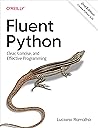
Don't waste time bending Python to fit patterns you've learned in other languages. Python's simplicity lets you become productive quickly, but often this means you aren't using everything the language has to offer. With the updated edition of this hands-on guide, you'll learn how to write effective, modern Python 3 code by leveraging its best ideas. Discover and apply idiomatic Python 3 features beyond your past experience. Author Luciano Ramalho guides you through Python's core language features and libraries and teaches you how to make your code shorter, faster, and more readable. Complete with major updates throughout, this new edition features five parts that work as five short books within the book: Data structures: Sequences, dicts, sets, Unicode, and data classes Functions as objects: First-class functions, related design patterns, and type hints in function declarations Object-oriented idioms: Composition, inheritance, mixins, interfaces, operator overloading, protocols, and more static types Control flow: Context managers, generators, coroutines, async/await, and thread/process pools Metaprogramming: Properties, attribute descriptors, class decorators, and new class metaprogramming hooks that replace or simplify metaclasses Review: Clear, concise and effective writing! - This is an excellent book for learning how to use the Python language proficiently. It is written for experienced developers, especially those who are experts in another language, but want to use Python effectively and elegantly. Chapter 1 explains the Python object model. It is very eye-opening, and is foundational to the goal of the book--teaching you how to write fluent Python code. The author advises that everyone should read chapter 1, then pick and choose topics of interest from the rest of the book. The topics covered in the next 23 chapters are too numerous to list here, but you are sure to find what you are looking for, unless you are looking for GUI programming, which isn't very elegant, no matter what. But I digress. This book is hefty, 980 pages long. It is packed with good information, no fluff. Example scripts are stripped down to illustrate precisely the concept being taught. You can run the examples if you want to, but you don't have to in order to learn what is being taught. The text is very well written. I highly recommend this book. Review: Great wisdom unlocked - First of all, let me just say that this isn't a book at all, it is some tome some wise ancient scribe wrote. I have been working in Technology for over 20 years now and I have been interested in it for probably another 20 years before that. In that time I have read many programming books, constantly looking for more advanced topics. I would read and be very disappointed, they were mostly always filled with fluff. I recently decided to finally give Python a try. I am at a point where I am doing more advanced projects and wanted a book to do just that. When I go to Stack Overflow or other sites like that for information. I want to be able to really understand the why behind some of the explanations. I don't want just to copy and paste. The book Python Crash Course helped get the basics down, this book has helped with the more advanced structure. There are two sections that have helped me the most: Functions as objects and Object-oriented idioms. I was going through many videos, Google searches, and some books to get a deeper understanding of this. this book is helping me to do just that. There is a lot of information in this book. Also, the index is decent. Many technology books lack in having a good one.



| Best Sellers Rank | #30,395 in Books ( See Top 100 in Books ) #6 in Object-Oriented Design #10 in Python Programming #16 in Computer Programming Languages |
| Customer Reviews | 4.7 out of 5 stars 768 Reviews |
G**_
Clear, concise and effective writing!
This is an excellent book for learning how to use the Python language proficiently. It is written for experienced developers, especially those who are experts in another language, but want to use Python effectively and elegantly. Chapter 1 explains the Python object model. It is very eye-opening, and is foundational to the goal of the book--teaching you how to write fluent Python code. The author advises that everyone should read chapter 1, then pick and choose topics of interest from the rest of the book. The topics covered in the next 23 chapters are too numerous to list here, but you are sure to find what you are looking for, unless you are looking for GUI programming, which isn't very elegant, no matter what. But I digress. This book is hefty, 980 pages long. It is packed with good information, no fluff. Example scripts are stripped down to illustrate precisely the concept being taught. You can run the examples if you want to, but you don't have to in order to learn what is being taught. The text is very well written. I highly recommend this book.
M**2
Great wisdom unlocked
First of all, let me just say that this isn't a book at all, it is some tome some wise ancient scribe wrote. I have been working in Technology for over 20 years now and I have been interested in it for probably another 20 years before that. In that time I have read many programming books, constantly looking for more advanced topics. I would read and be very disappointed, they were mostly always filled with fluff. I recently decided to finally give Python a try. I am at a point where I am doing more advanced projects and wanted a book to do just that. When I go to Stack Overflow or other sites like that for information. I want to be able to really understand the why behind some of the explanations. I don't want just to copy and paste. The book Python Crash Course helped get the basics down, this book has helped with the more advanced structure. There are two sections that have helped me the most: Functions as objects and Object-oriented idioms. I was going through many videos, Google searches, and some books to get a deeper understanding of this. this book is helping me to do just that. There is a lot of information in this book. Also, the index is decent. Many technology books lack in having a good one.
M**N
In depth with clear explanations.
This is definitely not a beginner book. I’m not one for doing things just to by “Pythonic” but this book gives good explanations of the practical reasons for many of the more current syntax and conventions besides just making fewer lines of code.
T**,
Intermediate to advanced Python
Contains everything you need to know about writing Python. Intermediate to advanced.
B**R
If you wanna get technical with python.
Great book! It explains the parts of python you might not learn any where else. A must have for python enthusiasts.
T**O
Must have for Python proo
Very practical. Very good for learning Python and for reference.
J**K
An Outstanding Book Diminished by Problems with the Kindle app on iPad
This is IMO the best advanced book on Python. I read the first edition five years ago or so - 900 pages - and am now working the through the second edition - 1500 pages. This book is not for the casual Python programmer, however. I have been writing Python code for more than twenty years, but I learn new things or sharpen my knowledge with every chapter. The coverage is comprehensive; the writing is very clear, and the example code is carefully annotated. I had been eagerly awaiting this new edition, which is a year or two late from the original publication date, but I am very disappointed with the Kindle version, which was fine in the first edition. While the Kindle app on my pc works fine, it does not work on my iPad, which has plenty of free memory. After just ten pages or so, the app freezes, and I cannot get any further. I cannot even jump to later points in the book. The publisher, O'Reilly, refuses to take any responsibility for this. Amazon, when contacted, promised to investigate and get back to me, but, in fact, I got no further response other than an offer of a refund, which I don't want. I am now reading the book on my iPad via a browser, but this has a lot of drawbacks.
D**I
Favorite Python book
My primary source for learning advanced Python
A**S
Best book on Python
Great content
L**.
Excelente livro, mas não é para iniciantes.
O livro é excelente e aprofunda vários (todos?) aspectos da linguagem. Não é um livro para iniciantes — se você for um, não compre esse livro agora —, mas para aqueles que já possuem no mínimo conhecimento intermediário de Python (o próprio autor menciona isso), visto que ele fornece um "algo a mais" àquilo que você sabe/acha que sabe. Acredito que seja o livro definitivo para programadores Python.
A**A
Bad experience
The book was ruined, I don't know if it's the shipping service, or something else, plus I thought it's colored not a 700sek for a BW version, trash
J**E
The Pythonic bible
Of course, we programmers know that everything we could want to know is out there, in fragmentary form, on the web. But I have a tediously fastidious mind that likes to keep the distinction clear between what I know and what I have yet to find out. As such, books are my preferred approach to a systematic learning process. I would have been very grateful then if someone had told me at the start of my Python journey that what and all I needed to read was the Tutorial at python.org, David Beasley's epically concise Python Distilled, and this, the 'lizard book'. This book demands a close, paragraph by paragraph reading and maybe some re-reading of some sections till full or at least deeper understanding dawns. After this book there isn't really anywhere to go except the source code and the dry and voluminous language docs. Whatever isn't actually in the book is there on the accompanying fpy.li website. A first point is that this is not a book for the beginner. One needs to have a reasonable grasp of the language having worked a while with it, being able to muddle along, but also knowing one is just muddling along and wishing to get things onto a more solid foundation. As such, I'm anxious not to let prospective readers be put off by the review that asserts that the author does not get to the point. There is no flab in this book. It is a big book, but a serious programmer could only wish that the book was even bigger and even more detailed. Python is as much an ideology about how to do things properly as a programming language. It is deceptively easy to muddle along in Python on the basis of what one has already come to know in more 'primitive' programming languages. But for the programmer determined to get the best from a language that has a near endless toolbox of subtle features and constructs the learning curve goes far deeper and longer than a superficial comprehension can suspect. Perhaps that reviewer is thinking about the soapbox sections at the end of each chapter in which the author considers the merits or not of particular decisions made in the complex, democratic language design process? If so, it should be pointed out that even here the author is inviting the reader to think more deeply and clearly about why such features were implemented as they were and what the alternatives might be. I have two complaints, notwithstanding which I still regard the book as indispensable and insubstitutable. Firstly, I wish very much there was a hardcover edition because the kind of reading this book demands means that the paperback cover is not going to survive even as much as a first reading. I would also like to see, perhaps in a future edition, a more comprehensive and systematic index. Again and again, one encounters situations where we know we have read something about this in 'the lizard book' but finding the requisite nugget or gem is not always that easy. The book does not work particularly well as a reference. A final point is that the book is a great pleasure to read without any loss of clarity. Although the author's knowledge is clearly formidable, he invites the reader to accompany him on a journey as a fellow traveller, pointing out the many small discoveries he has made in his own passage. One quickly comes to feel assured that even where one's own understanding might falter, everything you need to achieve understanding is written down there if one just reads it carefully enough. Few technical authors pass this test. The man is a natural teacher who always places himself in the point of view of the student and proceeds from there. A huge, rigorous, fractally detailed but profoundly enjoyable journey of a book. As simple as possible but no simpler. The mighty and beautiful 'lizard book'
T**L
Not for Novice but for Deep divers
Excellent book for understanding and must be used as a reference. It is not for the beginner and as such should not be expected as a tutorial. Once the basics are mastered, then this book comes in to explain why the way things work. For example, if you want to know what a higher order function is and how a map function works, this book is there for you. The indexing is excellent with alphabetical ordering. Deep dive with this book by your side is all I would say. Have not read even a quarter of the book but already impressed. Definitely a desktop reference.
Trustpilot
4 days ago
2 weeks ago