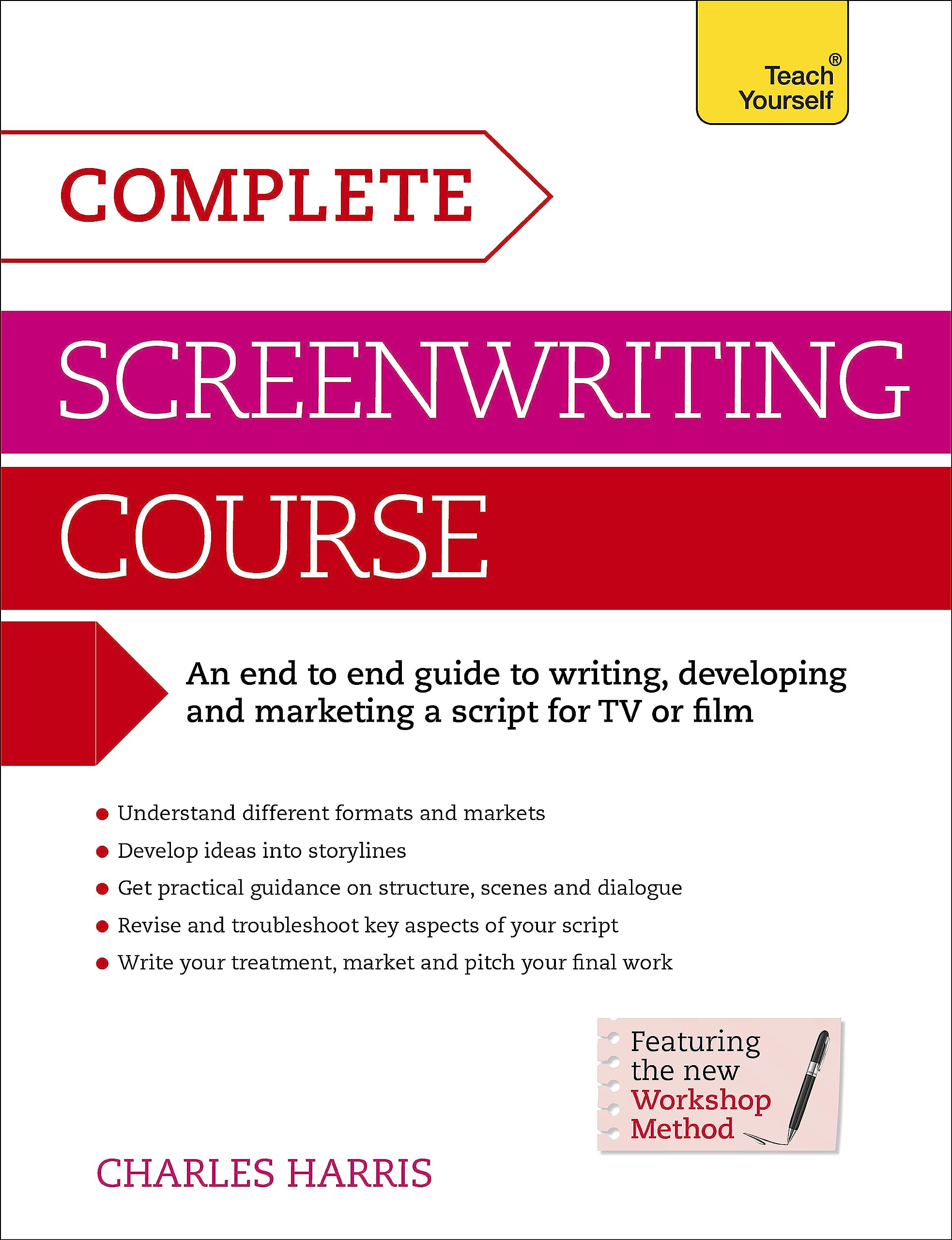
Buy Complete Screenwriting Course: A complete guide to writing, developing and marketing a script for TV or film (Teach Yourself) by Harris, Charles (ISBN: 9781471801761) from desertcart's Book Store. Everyday low prices and free delivery on eligible orders. Review: An in-depth discussion that every aspiring screenwriter must read! - This book is a must-have, but it is more of an in-depth discussion, than a simple how-to book! I bought it together with 'Save the Cat' and the two compliment one another almost perfectly. Whereas 'Save the Cat' gives one a ready made stencil for making Hollywood-style three-act movies, this book goes into all the nuts and bolts of all styles of film, TV series and episodic films, covering two-act films like Full Metal Jacket to seven-act beasts like Lawrence of Arabia. Again and again, the author Charles Harris emphasises the importance of imbuing each and every scene with what he calls GOATS (Goal, Obstacles, Action, Tactics, Stakes) and tells us that each and every scene must have all five present and all five must be strong. Otherwise the scene will falter. He also emphasises the need for brevity. I have read oodles of scripts and other written material and too many scripts are loaded with words, where fewer or none whatsoever were needed. He shows how to get a complicated concept across without words and gives the example of the question "Do you still love me?" can be answered in many ways that give different and complex answers, by not answering, hesitating or saying something totally unrelated. Inferences and innuendoes are more eloquent, he tells us, than speeches. At the end of each section, he gives workshop ideas and exercises. Even if you do not do them, you will gain, simply by thinking in depth about these exercises. The only negative thing I can find to say about this book, is the fact that it omits a few things that the aspiring screenwriter needs to know, even if they do not affect him/her directly. Firstly, yes, writing is a solitary task, but making movies is anything but! Any and every film is a huge team effort involving sometimes hundreds of people beavering away, to create a masterpiece (we hope!) Even the lowest budget movie involves dozens of people if it is to stand even a slim chance of success. The writer may not be aware of all these people, carpenters, composers, sound designers, CGI artists, gaffers, actors, make-up artists, the list just goes on and on. But the writer does have to be aware that he is part of a giant team. He may be alone when he or she kicks the whole thing off, but that halcyon state of affairs won't last long - there will be rewrites, on-set adjustments and script focus groups and workshops. The writer has to be ready for the task of joining a big team. Secondly, half the movie is sound and that is waaaay more than dialogue. It really helps the composer, the arranger(s), the sound designers and sound effects and Foley guys if the script is written with their needs in mind. That does not mean that the writer should churn out a Foleys script, but it does mean that he or she must be aware of how music or sound design can pull you through a story. Imagine Jacques Tati's masterpiece 'Playtime' without Foleys or the TV series Gotham without that brilliantly menacing score! Lastly, the subject of genres is discussed, but the pros and cons of the various types is not discussed. We need to think about popular taste and such subjects as why the movie-going public (but not the TV audience for soaps) just don't like gritty urban dramas (Dad, I'm pregnant! Look out, he's got a knife!) and why some demographic groups like some types of movies, but not others. In fact, the whole subject of demographic targeting is not covered. This is an excellent book and well worth the modest sticker price, but, like any book on any subject, it doesn't cover everything and as the author himself says, if you read 30 books on a subject, you own that subject. But books cannot replace reading and writing scripts! So if you want to learn how to write a movie script, buy this book, read it and then start writing! Trust me! The more you write, the better you get! Review: The hitchhiker’s guide to the journey of writing success for the screen. A must have, go to and screen writing bible. - A hitchhiker’s guide to the journey of writing for the screen. A must have. A go to. THE screen writing bible. A best friend and soul mate, with you on the challenging journey to screen writing success. This reads like a must have book for anyone who wants to write for the screen and at whatever stage in their personal journey from a wishful wannabe amateur to a serial best selling screenwriter. There are a lot of good screen writing books out there I’ve read most of them a few good but on the whole I have been largely been disappointed when the hype turns into nothing new, words are old or stolen or worse full of film references that mean zilch. So let me put it this way. This is the one book that stays by my side and is opened most days over and over. If my house was to burn down tomorrow, then this would be the one and only screen writing book I would save. It’s the best book on this subject for a whole heap of good reasons. As others have commented it has a unique layout that is inspired, logical and well crafted so readers get the maximum value from every single page and chapter. It’s cleverly designed so that I can either pick up or run on what I need to know now in the moment or read from front to the back. It covers the foundations of great writing, packed with relevant inspiring examples that aptly illustrate and instil good disciplines and building blocks through to developing high levels of craftsmanship’s and skills learnt by some of the writing greats to help become as an all round writer. It lets you just dip into the parts your stuck with and gives you usable exercises at the end of each chapter. The structure makes sure you really get it. By this I mean that you not only read and take in all in the words, references and theory and logic behind them, but they that they sink in. That they mean something and help you gain skills you can actually USE. This is the first time I have ever read a book that I can not only recall practically word for word because they jump out at me and are real, but that I can apply and use it for real into my daily work. I could go on about some of the great technical aspects of this inspired book chapter after chapter of condensed genius, but other reviewers have already done this so well. Most of all this books feels like Harris is your best friend, not lecturing, judging or preachy at you, but someone who understands your challenge and is really with you wanting you to succeed on my writing journey. Someone who is not just along for ride but really gets the real YOU like no one else can. Harris feels like he is my best friend who just happens to be a screen writing genius and not only knows but is willing to share with me all the secrets there is in the universe to the art and craft of writing for the screen. I really don’t know how he has achieved this special effect of getting down and real in this book, but he does like no other. This book is with you on the whole journey from the loneliness and joys of the blank page through to a scary professional Hollywood pitch and treatment and everything in between that a writer needs. What makes it stand out for me is that it not only delivers techniques wisdom and bottom line direction that really works, but the way it has helped me find and bring out my inner voice. It gets right in there, tears out your guts, drills down to your core and shows up in a writing “style”. As someone hard to please I cannot recommend this book highly enough. Two words. It works.
| ASIN | 1471801764 |
| Best Sellers Rank | 59,381 in Books ( See Top 100 in Books ) 24 in Film Screenwriting 970 in The Performing Arts 6,036 in Reference (Books) |
| Customer reviews | 4.6 4.6 out of 5 stars (321) |
| Dimensions | 19.05 x 1.91 x 24.77 cm |
| ISBN-10 | 9781471801761 |
| ISBN-13 | 978-1471801761 |
| Item weight | 1.05 kg |
| Language | English |
| Part of series | Teach Yourself: Writing |
| Print length | 352 pages |
| Publication date | 17 Oct. 2014 |
| Publisher | Teach Yourself |
A**E
An in-depth discussion that every aspiring screenwriter must read!
This book is a must-have, but it is more of an in-depth discussion, than a simple how-to book! I bought it together with 'Save the Cat' and the two compliment one another almost perfectly. Whereas 'Save the Cat' gives one a ready made stencil for making Hollywood-style three-act movies, this book goes into all the nuts and bolts of all styles of film, TV series and episodic films, covering two-act films like Full Metal Jacket to seven-act beasts like Lawrence of Arabia. Again and again, the author Charles Harris emphasises the importance of imbuing each and every scene with what he calls GOATS (Goal, Obstacles, Action, Tactics, Stakes) and tells us that each and every scene must have all five present and all five must be strong. Otherwise the scene will falter. He also emphasises the need for brevity. I have read oodles of scripts and other written material and too many scripts are loaded with words, where fewer or none whatsoever were needed. He shows how to get a complicated concept across without words and gives the example of the question "Do you still love me?" can be answered in many ways that give different and complex answers, by not answering, hesitating or saying something totally unrelated. Inferences and innuendoes are more eloquent, he tells us, than speeches. At the end of each section, he gives workshop ideas and exercises. Even if you do not do them, you will gain, simply by thinking in depth about these exercises. The only negative thing I can find to say about this book, is the fact that it omits a few things that the aspiring screenwriter needs to know, even if they do not affect him/her directly. Firstly, yes, writing is a solitary task, but making movies is anything but! Any and every film is a huge team effort involving sometimes hundreds of people beavering away, to create a masterpiece (we hope!) Even the lowest budget movie involves dozens of people if it is to stand even a slim chance of success. The writer may not be aware of all these people, carpenters, composers, sound designers, CGI artists, gaffers, actors, make-up artists, the list just goes on and on. But the writer does have to be aware that he is part of a giant team. He may be alone when he or she kicks the whole thing off, but that halcyon state of affairs won't last long - there will be rewrites, on-set adjustments and script focus groups and workshops. The writer has to be ready for the task of joining a big team. Secondly, half the movie is sound and that is waaaay more than dialogue. It really helps the composer, the arranger(s), the sound designers and sound effects and Foley guys if the script is written with their needs in mind. That does not mean that the writer should churn out a Foleys script, but it does mean that he or she must be aware of how music or sound design can pull you through a story. Imagine Jacques Tati's masterpiece 'Playtime' without Foleys or the TV series Gotham without that brilliantly menacing score! Lastly, the subject of genres is discussed, but the pros and cons of the various types is not discussed. We need to think about popular taste and such subjects as why the movie-going public (but not the TV audience for soaps) just don't like gritty urban dramas (Dad, I'm pregnant! Look out, he's got a knife!) and why some demographic groups like some types of movies, but not others. In fact, the whole subject of demographic targeting is not covered. This is an excellent book and well worth the modest sticker price, but, like any book on any subject, it doesn't cover everything and as the author himself says, if you read 30 books on a subject, you own that subject. But books cannot replace reading and writing scripts! So if you want to learn how to write a movie script, buy this book, read it and then start writing! Trust me! The more you write, the better you get!
J**D
The hitchhiker’s guide to the journey of writing success for the screen. A must have, go to and screen writing bible.
A hitchhiker’s guide to the journey of writing for the screen. A must have. A go to. THE screen writing bible. A best friend and soul mate, with you on the challenging journey to screen writing success. This reads like a must have book for anyone who wants to write for the screen and at whatever stage in their personal journey from a wishful wannabe amateur to a serial best selling screenwriter. There are a lot of good screen writing books out there I’ve read most of them a few good but on the whole I have been largely been disappointed when the hype turns into nothing new, words are old or stolen or worse full of film references that mean zilch. So let me put it this way. This is the one book that stays by my side and is opened most days over and over. If my house was to burn down tomorrow, then this would be the one and only screen writing book I would save. It’s the best book on this subject for a whole heap of good reasons. As others have commented it has a unique layout that is inspired, logical and well crafted so readers get the maximum value from every single page and chapter. It’s cleverly designed so that I can either pick up or run on what I need to know now in the moment or read from front to the back. It covers the foundations of great writing, packed with relevant inspiring examples that aptly illustrate and instil good disciplines and building blocks through to developing high levels of craftsmanship’s and skills learnt by some of the writing greats to help become as an all round writer. It lets you just dip into the parts your stuck with and gives you usable exercises at the end of each chapter. The structure makes sure you really get it. By this I mean that you not only read and take in all in the words, references and theory and logic behind them, but they that they sink in. That they mean something and help you gain skills you can actually USE. This is the first time I have ever read a book that I can not only recall practically word for word because they jump out at me and are real, but that I can apply and use it for real into my daily work. I could go on about some of the great technical aspects of this inspired book chapter after chapter of condensed genius, but other reviewers have already done this so well. Most of all this books feels like Harris is your best friend, not lecturing, judging or preachy at you, but someone who understands your challenge and is really with you wanting you to succeed on my writing journey. Someone who is not just along for ride but really gets the real YOU like no one else can. Harris feels like he is my best friend who just happens to be a screen writing genius and not only knows but is willing to share with me all the secrets there is in the universe to the art and craft of writing for the screen. I really don’t know how he has achieved this special effect of getting down and real in this book, but he does like no other. This book is with you on the whole journey from the loneliness and joys of the blank page through to a scary professional Hollywood pitch and treatment and everything in between that a writer needs. What makes it stand out for me is that it not only delivers techniques wisdom and bottom line direction that really works, but the way it has helped me find and bring out my inner voice. It gets right in there, tears out your guts, drills down to your core and shows up in a writing “style”. As someone hard to please I cannot recommend this book highly enough. Two words. It works.
M**F
Good course
It is a when written, helpful and enjoyable book
A**R
"THIS IS THE ONLY BOOK ON SCREENWRITING YOU'LL EVER NEED"
Charlie Harris's book on "Complete Screenwriting Course: Teach Yourself. I find to be the best book on screenwriting yet! For years I have purchased books on the craft of screenwriting. Hoping one day I would find a comprehensive book, which would guide me through the three-act structure. Now, I have found the book, which I have been seeking for years!... I found it in Charlie Harris's book, there's nothing left out. The book takes you from the conception of an idea right through to the finished draft... I have read many books on the craft of screenwriting. Bu famous authors such as Syd Field, Phil Gladwin and Blake Snyder. My advice is to purchase this book on screenwriting. You won't need to buy any other book. It puts other screenwriting gurus like Syd field, Phil Gladwin and Blake Snyder to shame. No other book covers the advice, tips and information which Charlie Harris provides... As well as a very informative book, it's a joy to read. I'm working on a script now using the techniques, advice and tips. I have every confidence in producing a first-class script... Best wishes, Charlie. Dave Oman
T**2
Excellent!!!
L**N
Very good
A**T
Very nice book
S**T
You want to develop, write, market a TV or Movie Script, learn, practice, strengthen your writing. No money or little to afford a prestigious Course, limited time to learn, you live far far away then “Screenwriting Course” by Charles Harris is perfect for you. I have read now over 30 Screenwriting books, all good, all got Chapters which are great to read, Charles Harris “Screenwriting Course” is one I hold in high regards. A professional who presents you with a Course for wherever you are, whenever you want to learn, excellent, precise, key Ideas, points to focus on, and affordable, a book to keep, read and read again.
P**O
Charles Harris did an amazing book for screenwriters who do not have money and time to do a course about making a script. Very useful for those who want try to do a rewarded script. I discovered it in Raindance Film Festival web and I don't apologize about buy it. It is easy to understand, and teaches you step by step.
Trustpilot
2 days ago
1 month ago


