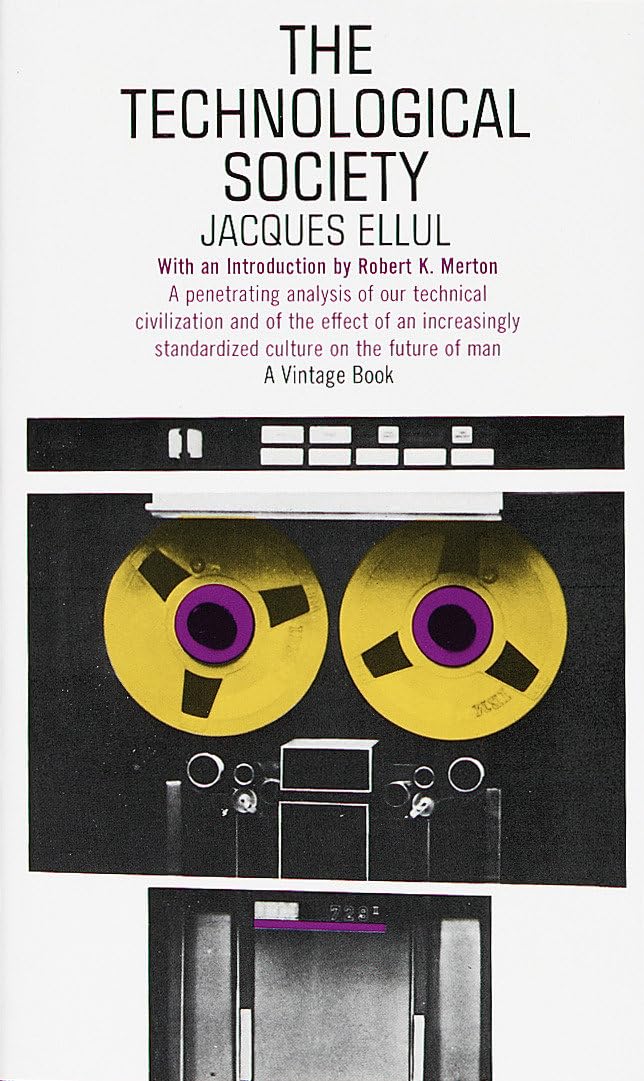
The Technological Society [Jacques Ellul, John Wilkinson, Robert K. Merton] on desertcart.com. *FREE* shipping on qualifying offers. The Technological Society Review: Technique - the bedrock of the modern world - Before proceeding with this review, let me just say that no fewer than a hundred pages could be trimmed from its content without diluting its message at all. Many of the examples used in the book are extremely dated; while I think I'm fairly well read, I confess that I'm not really up on the vicissitudes and catfights of French academic sociology in the early 1960's (to give but one example). With that being said, this book is worth well worth the time spent reading its 436 pages. This is undoubtedly one of the most important books of the twentieth century, and if you accept its thesis you won't be able to look at the political milieu in the same way ever again. (If you agree with it and it doesn't change the way you look at things, you haven't grasped its importance.) Most political theorists take ideology to be a central point from which "real world" consequences emanate. In other words, a Communist or libertarian ideology in practical use will produce a particular type society and individual divorced from the actual technical workings of the society. Liberals and conservatives both speak of things in such a manner as if ideology is the prima facie cause of existence - but as Ellul shows in painstaking detail, this is wrong. What almost everyone fails to grasp is the pernicious effect of technique (and its offspring, technology) on modern man. Technique can loosely be defined as the entire mass of organization and technology that has maximum efficiency as its goal. Ellul shows that technique possesses an impetus all its own and exerts similar effects on human society no matter what the official ideology of the society in question is. Technique, with its never-ending quest for maximum efficiency, tends to slowly drown out human concerns as it progresses towards its ultimate goal. "...the further economic technique develops, the more it makes real the abstract concept of economic man." (p. 219) Technique does not confine itself merely to the realm of technical production, but infiltrates every aspect of human existence, and has no time for "inefficiencies" caused by loyalties to family, religion, race, or culture; a society of dumbed-down consumers is absolutely essential to the technological society, which must contain predictable "demographics" in order to ensure the necessary financial returns. "The only thing that matters technically is yield, production. This is the law of technique; this yield can only be obtained by the total mobilization of human beings, body and soul, and this implies the exploitation of all human psychic forces." (p. 324). Ellul thoroughly shows that much of the difference in ideology between libertarians and socialists becomes largely irrelevant in the technological society (this is not to say that ideology is unimportant, but rather that technique proceeds with the same goals and effects.) This will doubtlessly please no one; liberals want to believe that they can have privacy and freedom despite a high degree of central planning, and libertarians want to believe that a society free of most regulation and control is possible in an advanced technological society. Libertarian fantasies seem especially irrelevant given the exigencies of a technological society; as Ellul notes, as technique progresses it simply cannot function without a high degree of complexity and regulation. "The modern state could no more be a state without techniques than a businessman could be a businessman without the telephone or the automobile... not only does it need techniques, but techniques need it. It is not a matter of chance, nor a matter of conscious will; rather, it is an urgency..." (p. 253-254). Can anyone really doubt Ellul here, especially seeing as how twenty-plus years of conservative promises to downsize government still result in more regulation and bureaucracy with every passing year? Planning, socialism, regulation, and control are the natural consequences of technique; an increasingly incestuous relationship between industry and the State is inevitable. "The state and technique - increasingly interrelated - are becoming the most important forces in the modern world; they buttress and reinforce each other in their aim to produce an apparently indestructible, total civilization." (p. 318). This is not an optimistic book. Given that the nature of technique is one of a universal leveling of human cultures, needs, and desires (replacing real needs with false ones and the neighborhood restaurant with McDonalds), Ellul is certainly pessimistic. He does not propose any remedies for the Skinnerist nightmares of technique somehow leading to a Golden Age of humanity, where people will enjoy maximal freedom coupled with minimal want: "...we are struck by the incredible naivete of these scientists... they claim they will be in a position to develop certain collective desires, to constitute certain homogeneous social units out of aggregates of individuals, to forbid men to raise their children, and even to persuade them to renounce having any... at the same time, they speak of assuring the triumph of freedom and of the necessity of avoiding dictatorship... they seem incapable of grasping the contradiction involved, or of understanding that what they are proposing." (p. 434). Review: Perhaps the Most Important Book Ever Written Examining and Critquing the Modern Technological Society and Globalization! - I loved this book! It was rather tough to get through and somewhat dry and boring in many parts, but the information and thought put into this text is top notch. I do not think I am overstating when I say that Jacques Ellul's The Technological Society is probably one of the most important works of the 20th Century, which is probably why it is off the radar of most people (the technological society tends to protect itself by ignoring its obvious faults and all useful critiques). The text is translated by John Wilkinson and is a whopping 450+ pages (introductions, notes and index included). It explains what 'technique' is, 'technique' and economy, 'technique' and the state, human techniques, and where we are headed. If you ever heard of a 'New World Order' or you thought it was all a bunch of hooey, then you need to read this book. The 'New World Order' is not a noun or pronoun, but a philosophical term used by many (I'll admit not directly by Jacques Ellul) to indicate a change in the world system, and a signficant change in the world system or order and its effects is exactly what this book is about! Jacques Ellul (from his Christian perspective) pretty much calls the Technological Society Behemoth or, The Beast. Don't get me wrong! Jacques Ellul does not take a religious stance, but more of a logical "it then follows" or "is already apparent" stance. His 'Behemoth' commentary is merely his own subjective way of describing the obvious. This is a great book that can and will open your eyes to how the world really works and where it is most likely headed. Whether you agree with Ellul or not, you will be a better person and much more informed if you take the time to read this text. Jacques Ellul's The Technological Society is, in my opinion, one of the most important books you can ever read and it should be required reading in every school (and homeschooling group) everywhere. There are certain books which have a profound impact upon your consciousness, and although I knew much of what Ellul stated beforehand due to my interests, I cannot recommend this book enough. If I could I would give this book 10 stars and will emphatically state that it should be in everyone's required reading library.
| Best Sellers Rank | #55,098 in Books ( See Top 100 in Books ) #8 in Social Aspects of Technology #17 in Engineering (Books) #214 in History & Theory of Politics |
| Customer Reviews | 4.5 4.5 out of 5 stars (305) |
| Dimensions | 4.18 x 1.25 x 6.89 inches |
| ISBN-10 | 0394703901 |
| ISBN-13 | 978-0394703909 |
| Item Weight | 11.2 ounces |
| Language | English |
| Print length | 449 pages |
| Publication date | January 1, 1964 |
| Publisher | Vintage Books |
P**N
Technique - the bedrock of the modern world
Before proceeding with this review, let me just say that no fewer than a hundred pages could be trimmed from its content without diluting its message at all. Many of the examples used in the book are extremely dated; while I think I'm fairly well read, I confess that I'm not really up on the vicissitudes and catfights of French academic sociology in the early 1960's (to give but one example). With that being said, this book is worth well worth the time spent reading its 436 pages. This is undoubtedly one of the most important books of the twentieth century, and if you accept its thesis you won't be able to look at the political milieu in the same way ever again. (If you agree with it and it doesn't change the way you look at things, you haven't grasped its importance.) Most political theorists take ideology to be a central point from which "real world" consequences emanate. In other words, a Communist or libertarian ideology in practical use will produce a particular type society and individual divorced from the actual technical workings of the society. Liberals and conservatives both speak of things in such a manner as if ideology is the prima facie cause of existence - but as Ellul shows in painstaking detail, this is wrong. What almost everyone fails to grasp is the pernicious effect of technique (and its offspring, technology) on modern man. Technique can loosely be defined as the entire mass of organization and technology that has maximum efficiency as its goal. Ellul shows that technique possesses an impetus all its own and exerts similar effects on human society no matter what the official ideology of the society in question is. Technique, with its never-ending quest for maximum efficiency, tends to slowly drown out human concerns as it progresses towards its ultimate goal. "...the further economic technique develops, the more it makes real the abstract concept of economic man." (p. 219) Technique does not confine itself merely to the realm of technical production, but infiltrates every aspect of human existence, and has no time for "inefficiencies" caused by loyalties to family, religion, race, or culture; a society of dumbed-down consumers is absolutely essential to the technological society, which must contain predictable "demographics" in order to ensure the necessary financial returns. "The only thing that matters technically is yield, production. This is the law of technique; this yield can only be obtained by the total mobilization of human beings, body and soul, and this implies the exploitation of all human psychic forces." (p. 324). Ellul thoroughly shows that much of the difference in ideology between libertarians and socialists becomes largely irrelevant in the technological society (this is not to say that ideology is unimportant, but rather that technique proceeds with the same goals and effects.) This will doubtlessly please no one; liberals want to believe that they can have privacy and freedom despite a high degree of central planning, and libertarians want to believe that a society free of most regulation and control is possible in an advanced technological society. Libertarian fantasies seem especially irrelevant given the exigencies of a technological society; as Ellul notes, as technique progresses it simply cannot function without a high degree of complexity and regulation. "The modern state could no more be a state without techniques than a businessman could be a businessman without the telephone or the automobile... not only does it need techniques, but techniques need it. It is not a matter of chance, nor a matter of conscious will; rather, it is an urgency..." (p. 253-254). Can anyone really doubt Ellul here, especially seeing as how twenty-plus years of conservative promises to downsize government still result in more regulation and bureaucracy with every passing year? Planning, socialism, regulation, and control are the natural consequences of technique; an increasingly incestuous relationship between industry and the State is inevitable. "The state and technique - increasingly interrelated - are becoming the most important forces in the modern world; they buttress and reinforce each other in their aim to produce an apparently indestructible, total civilization." (p. 318). This is not an optimistic book. Given that the nature of technique is one of a universal leveling of human cultures, needs, and desires (replacing real needs with false ones and the neighborhood restaurant with McDonalds), Ellul is certainly pessimistic. He does not propose any remedies for the Skinnerist nightmares of technique somehow leading to a Golden Age of humanity, where people will enjoy maximal freedom coupled with minimal want: "...we are struck by the incredible naivete of these scientists... they claim they will be in a position to develop certain collective desires, to constitute certain homogeneous social units out of aggregates of individuals, to forbid men to raise their children, and even to persuade them to renounce having any... at the same time, they speak of assuring the triumph of freedom and of the necessity of avoiding dictatorship... they seem incapable of grasping the contradiction involved, or of understanding that what they are proposing." (p. 434).
K**R
Perhaps the Most Important Book Ever Written Examining and Critquing the Modern Technological Society and Globalization!
I loved this book! It was rather tough to get through and somewhat dry and boring in many parts, but the information and thought put into this text is top notch. I do not think I am overstating when I say that Jacques Ellul's The Technological Society is probably one of the most important works of the 20th Century, which is probably why it is off the radar of most people (the technological society tends to protect itself by ignoring its obvious faults and all useful critiques). The text is translated by John Wilkinson and is a whopping 450+ pages (introductions, notes and index included). It explains what 'technique' is, 'technique' and economy, 'technique' and the state, human techniques, and where we are headed. If you ever heard of a 'New World Order' or you thought it was all a bunch of hooey, then you need to read this book. The 'New World Order' is not a noun or pronoun, but a philosophical term used by many (I'll admit not directly by Jacques Ellul) to indicate a change in the world system, and a signficant change in the world system or order and its effects is exactly what this book is about! Jacques Ellul (from his Christian perspective) pretty much calls the Technological Society Behemoth or, The Beast. Don't get me wrong! Jacques Ellul does not take a religious stance, but more of a logical "it then follows" or "is already apparent" stance. His 'Behemoth' commentary is merely his own subjective way of describing the obvious. This is a great book that can and will open your eyes to how the world really works and where it is most likely headed. Whether you agree with Ellul or not, you will be a better person and much more informed if you take the time to read this text. Jacques Ellul's The Technological Society is, in my opinion, one of the most important books you can ever read and it should be required reading in every school (and homeschooling group) everywhere. There are certain books which have a profound impact upon your consciousness, and although I knew much of what Ellul stated beforehand due to my interests, I cannot recommend this book enough. If I could I would give this book 10 stars and will emphatically state that it should be in everyone's required reading library.
K**A
Still pertinent and modern today
It's hard to believe that this book was written almost 60 years ago. Most of our current technological problems are the same: environments that breathe are destroyed for short-sighted reasons and/or for profit -- here today and gone tomorrow; something that started out good, cell phones for example, have taken over our lives. "How did we manage 10 years ago without a telephone in our pocket?" Amazingly, most teenagers today have never held a receiver to their ear or heard a dial tone. In many ways this is a frightening book; it's also enlightening. A heady read, not easy, but worth every bit of the time spent.
D**O
I agree with the previous two reviews of this most profound and solemn work, Full of insight that few such as Ellul can give. Definitely worth the read!!!
T**I
The print is all blur towards the bottom portion of the book. The cover page is different from the one shown on the amazon page.
I**A
Ellul‘s These, dass die technologische „Wesenheit“ (die Maschine), die dabei ist die Erde zu zerstören, uns Menschen schon längst assimiliert und zu ihren willenlosen Werkzeugen umfunktioniert hat, ist ein erfrischender „neuer“ (Buch ist von 1956) Blickwinkel. Parallelen werden sichtbar zu Hans Hass‘ wenig beachteter, aber dennoch trefflicher Energontheorie. Das Buch ist etwas langatmig bzw zu ausführlich geschrieben, was aber vielleicht der damaligen Zeit geschuldet ist. Als Priester und Franzose war er natürlich auch geistig doppelt gehandicapt, vielleicht auch daher diese Ausführlichkeit. Trotzdem definitiv empfehlenswert.
I**N
Ellul uses a dialectical approach to understanding the technical phenomenon in contemporary societies around the world and its ramification on Man: conceptions of Man's place in Nature, Man's place in Society, and Humanity's relation to Itself. This leads to three 'arrays' of technical phenomenon: Technique and the State, Technique and Economy, and Human Techniques, that is Man as the object of Technique. The underlying is a penetrating analysis of Humanity as existed prior to the Industrial Revolution (roughly speaking circa 1730) and a new conception of Humanity in relation, not to itself or nature, but to Technique. For Ellul, we are a different civilization altogether and not a continuation of past civilizations. In other words, we are a different species than our ancestors. Whereas our ancestors were largely subordinate to nature, metaphysics, and tradition, we and our contemporaries are totally subordinate to Technical phenomena. It is this conclusion, that worries Ellul, as one is forced to revisit one's naive conceptions of liberty, consciousness, free will, religion, progress and ultimately the meaning of one's life. This is what makes this book so powerful and transformative. 'The Technological Society' is not a historical analysis but a sociological one with serious implications for politics, discourse, theology, ethics, and consumption. It is exceedingly well researched. I counted over 400 books in the bibliography of the English version, which according to the translators, is less extensive than the original French version. The bibliography also excludes titles used for 'Propaganda', and the 'Political Illusion', two other books that follow from the points made in 'The Technological Society'. This book will blow your mind away forever.
A**G
I liked reading this book. Some books carry on about annoying nonsense, but this book is the special kind of nonsense that I enjoy.
Trustpilot
1 month ago
4 days ago


